

Platform Engineering · Governance · DevSecOps
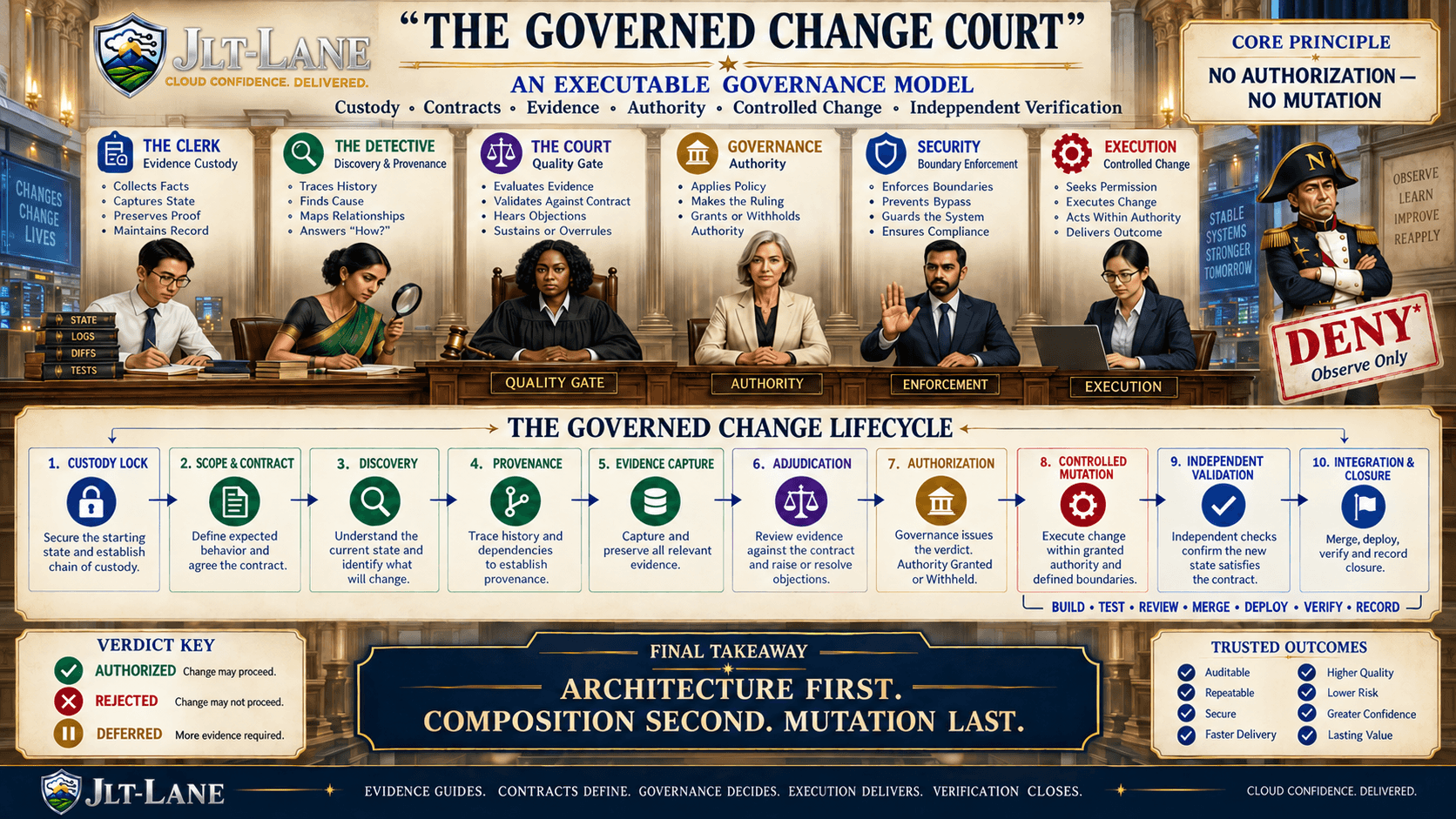
The Governed Change Court
An executable governance model for evidence-led, contract-driven, and independently verified platform change.
The operating-model problem
Tools execute. Governance decides.
Platform changes often fail because execution begins before custody, authority, and expected outcomes have been established. A command may be technically correct while still acting on the wrong branch, artifact, consumer, or production boundary.
The Governed Change Court turns those risks into an executable workflow. Evidence is collected before conclusions are drawn. Contracts define success. Authority is deliberately bounded. Mutation occurs only after authorization, and verification is independent from the mechanism that produced the change.
Executable lifecycle
Ten gates from custody to closure
Custody Lock
Confirm the repository, branch, HEAD, remote, and worktree state before interpreting or changing anything.
Scope & Contract
Define the expected behavior, authorized boundaries, invariants, and explicit stop conditions.
Discovery
Inventory the system before acting so live authorities are separated from abandoned or duplicate artifacts.
Provenance
Trace producers, consumers, history, and fingerprints to establish where authority actually resides.
Evidence Capture
Preserve hashes, diffs, logs, counters, routes, and observed state as reviewable evidence.
Adjudication
Compare the evidence with the contract, hear objections, and distinguish defects from intentional state.
Authorization
Grant the smallest mutation authority needed—or withhold it when evidence remains incomplete.
Controlled Mutation
Change only the authorized targets while preserving unrelated files and rollback boundaries.
Independent Validation
Use separate validators, tests, builds, and runtime checks to prove that the result satisfies the contract.
Integration & Closure
Review, merge, deploy, verify production, preserve the record, and explicitly exhaust temporary authority.
Guardrails
Evidence that constrains execution
Final takeaway
Architecture first. Composition second. Mutation last.
Governed change is not bureaucracy. It is the operating discipline that makes platform work auditable, repeatable, reversible, and safe enough to scale.